FSP
Future Storm Protection
Proposed control level
- Uses forward-looking climate assumptions.
- Would remove CSO discharges in the projected 2050 Typical Year.
- Already represents a major climate-forward infrastructure obligation.


The Draft Updated CSO Long-Term Control Plan will shape obligations for decades. The Advisory Board supports continued CSO progress and cleaner rivers. We also believe the next decision must be made with full visibility into the value delivered, the burden imposed, and the impact on communities ultimately responsible for paying.
Start with the Dashboard, understand the choice before the region, then use the questions below to decide what you want to say during public review.
The Draft Updated CSO Long-Term Control Plan is in public review, with comments due September 30, 2026. Communities, officials, staff, and stakeholders should understand what each alternative delivers, what it costs, and how those obligations would fall across communities.
The choice is not whether cleaner rivers matter. They do. The choice is how far the region should go, what additional value that delivers, and who carries the obligation.
What remaining discharges are being addressed?
Which planning options drive the central cost comparison?
Who pays, when, and for how long?
The broader planning process evaluated multiple control levels. The Dashboard focuses on FSP and ESP because they show the difference between the proposed control level and the higher-control alternative.
Proposed control level
Higher-control alternative
Core Advisory Board Question
Does the added benefit justify the added community obligation?
Remaining CSO controls
How far the region should go in controlling remaining combined sewer overflows.
The alternative selected
Whether the plan should proceed with Future Storm Protection or go further toward Extreme Storm Protection.
Community responsibility
How costs, debt service, construction impacts, and long-term obligations fall on communities and ratepayers.
Whether sewage in waterways is acceptable
It is not.
Whether stormwater or urban flooding matter
They do, but they are not solved by a CSO-only mandate.
Whether higher control is automatically better policy
The question is whether the added public benefit justifies the added obligation.
Downloadable Excel file
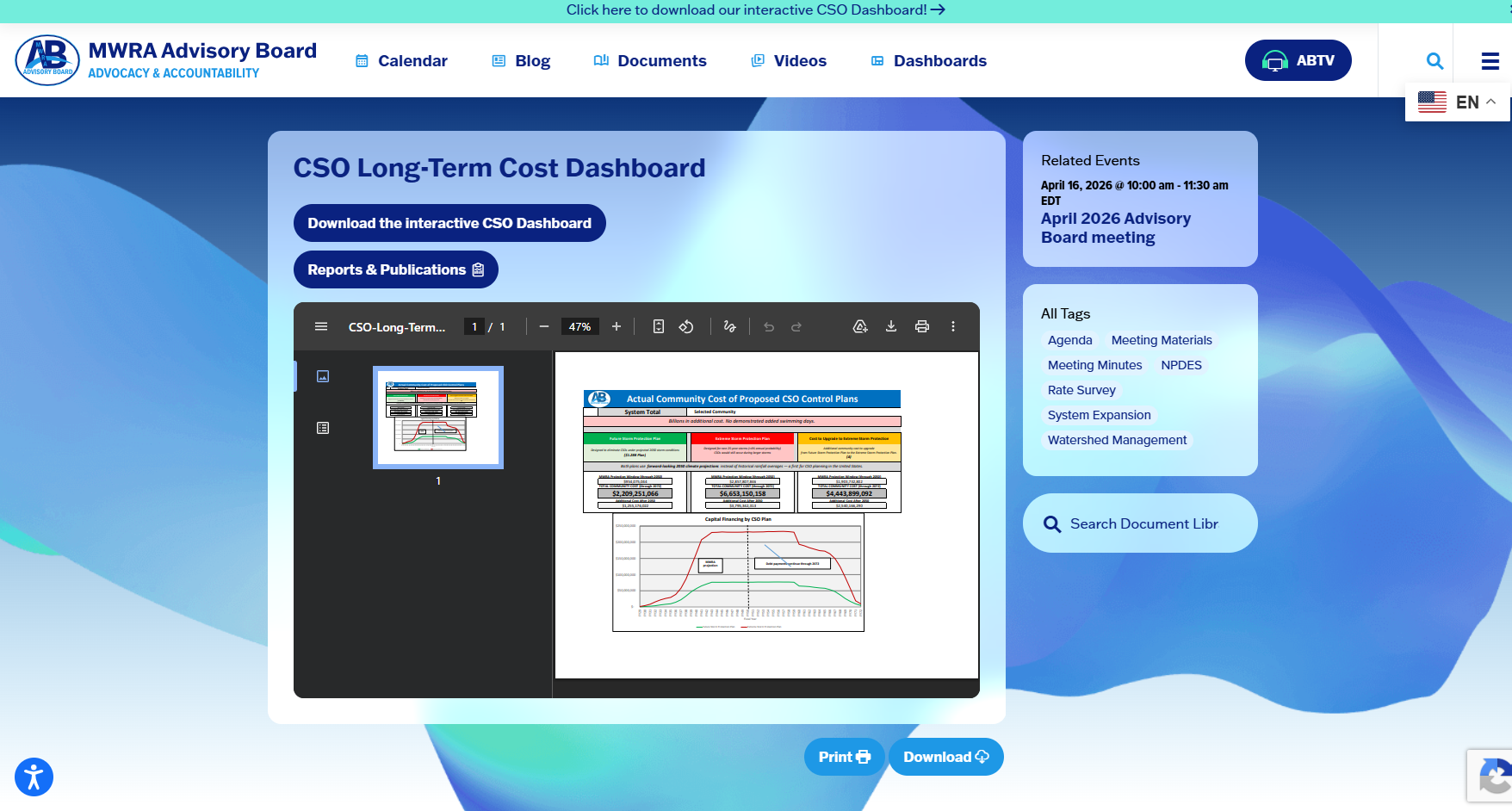
The Advisory Board’s downloadable Excel Dashboard translates regional CSO alternatives into community-level cost estimates. It helps users see how costs are distributed, when they are paid, and how long communities would carry the obligation.
Use the Dashboard to see:
The Dashboard focuses on these two alternatives because they define the central community-cost comparison. Both are forward-looking. The question is how far beyond the Future Storm Protection standard the region should go.
New to CSOs? Start here. These short explainers give enough background to follow the plan, the Dashboard, and the public-comment process.
A CSO happens when an older combined sewer system carrying both sewage and stormwater reaches capacity during wet weather and releases overflow to a nearby waterway.
CSO outfalls were designed as relief points. During heavy rain, they reduce the risk of sewage backing up into basements, streets, and buildings.
CSOs can discharge sewage and stormwater into waterways. Reducing them remains an important public-health and environmental goal.
The selected design standard determines the level of infrastructure required, the cost, the construction burden, and what kinds of storms the system is expected to control.
☔Stormwater
Stormwater and runoff remain major contributors to water-quality conditions.
⌁CSOs
CSO pollution is real, and reducing discharges remains important.
▣Other sources
Dry-weather sources, upstream conditions, and other pollution pathways also affect river outcomes.
A higher-control CSO requirement may sound like the finish line. But if stormwater and other pollution sources continue to shape water quality, the region could spend substantially more without proportionate improvement in the river conditions people expect.
The question is not whether cleaner rivers matter. They do. The question is whether each additional level of CSO control delivers enough documented benefit to justify the full cost and community burden.
The community is where the bill becomes real. Any higher-control requirement should be evaluated across the full set of obligations it creates, not just the headline construction cost.
Capital costLook forTotal project cost and who pays.
Why it mattersSystemwide scale can hide community-level obligation.
Debt serviceLook forHow long costs remain in assessments.
Why it mattersRepayment can extend decades beyond construction.
Construction impactsLook forDisruption, staging, access, and neighborhood impacts.
Why it mattersEnvironmental infrastructure still has local consequences.
Land and open spaceLook forPotential use of parks, fields, or constrained urban sites.
Why it mattersSome impacts are not captured by dollars alone.
Opportunity costLook forWhat else communities and ratepayers need to fund.
Why it mattersCSOs are part of a broader long-term capital-pressure picture.
Use these as a staff briefing tool, comment-letter checklist, meeting prep guide, or local conversation starter.
The decision should be grounded in documented incremental benefit, not only the idea that a higher-control standard sounds stronger.
If stormwater and other pollution sources remain, a CSO-only mandate may not produce the river conditions the public assumes it will.
The Dashboard is intended to help translate regional alternatives into community-level financial exposure.
Debt service, repayment timing, and the long tail of assessments should be part of the decision.
Construction disruption, staging, access, land needs, and neighborhood impacts should be visible alongside project costs.
CSOs are part of a broader long-term capital-pressure picture that also includes water, wastewater, stormwater, climate, housing, transportation, schools, and other priorities.
Public comments on the Draft Updated CSO Long-Term Control Plan are due September 30, 2026. Use the Dashboard, the questions above, and your local knowledge to help bring community impacts into the public-review record.
▦
Download the Advisory Board’s Excel-based Dashboard to see how regional alternatives translate into community-level costs, timing, and long-term obligations.
▶
Use this page, the Dashboard, and the walkthrough video to brief local officials, staff, boards, councils, or community stakeholders.
?
You do not need a full technical filing to participate. Useful comments can ask clear questions about added benefit, local impacts, cost timing, and tradeoffs.
✎
Comments can be submitted online, by email, by mail, or verbally at a virtual public hearing. The Partners’ project page includes the current submission instructions and hearing registration links.