
After four years of planning, an unusually divided Advisory Board vote on combined sewer overflows offers a glimpse of the difficult infrastructure decisions facing MWRA communities.
But that was part of the judgment facing the MWRA Advisory Board on October 22.
The Advisory Board adopted its comments on the Updated Combined Sewer Overflow (CSO) Long-Term Control Plan with 20 representatives voting in favor, four opposed, and ten abstaining. Together, the 34 participating representatives accounted for 77.6% of the Board’s total voting strength, with the Yes votes representing 81.4% of the voting strength present.
The vote at a glance
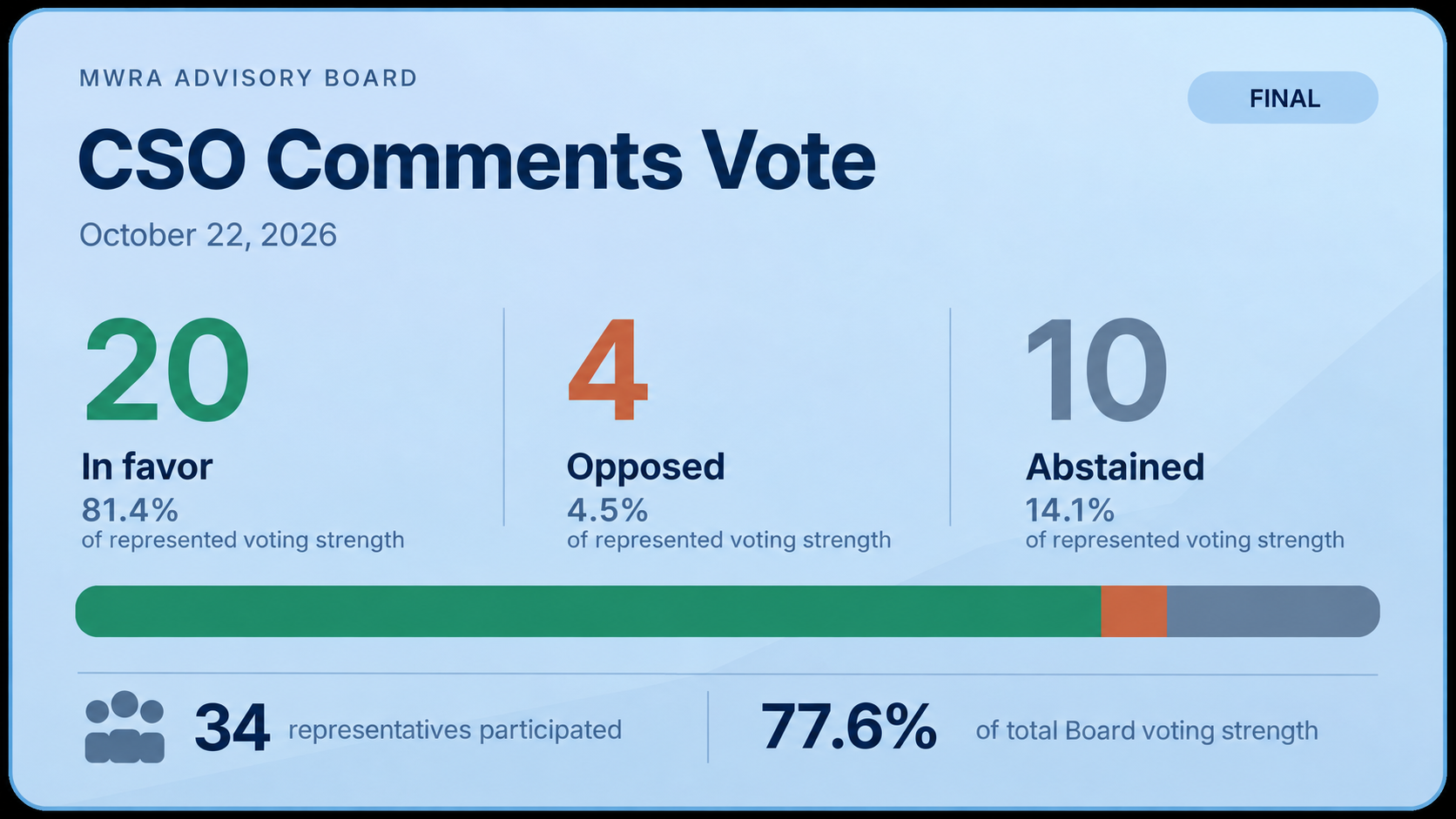
Percentages are assessment-weighted shares of the voting strength participating, not shares of individual representatives.
That result stands out. Nearly every Advisory Board vote in recent years has been unanimous. This one wasn’t.
After more than four years of planning, MWRA and its partners in Cambridge and Somerville have developed a proposal for the next generation of CSO control. The recommended approach carries an estimated $1.29 billion capital cost. More aggressive alternatives climb to nearly $4.74 billion, while a less expensive option would provide a more limited level of control.
The Advisory Board supported the Partners’ proposed level of CSO control—not a particular package of projects or a specific spending authorization. Some member communities believed even that approach would be too costly for what it delivers. Others supported the Advisory Board’s position while making the case for a less expensive alternative in their own comments to regulators.
What makes this unusual disagreement interesting isn’t simply that members voted differently. It’s what they were being asked to decide—and what the decision tells us about the choices still ahead.
A billion-dollar difference. And then some.
The Updated CSO Long-Term Control Plan is the product of work that began in 2022, including extensive technical analysis, regulatory coordination, seven official public meetings, and numerous opportunities for community engagement.
It also builds on decades of earlier investment that dramatically reduced combined sewer overflows into the region’s waterways.
The Partners’ recommended approach, which the Advisory Board has termed Future Storm Protection, would pursue zero modeled CSO discharges during a climate-adjusted 2050 Typical Year. The Advisory Board supports that level of control and recognizes the substantial investment it entails.
Importantly, that recommendation does not constitute approval of individual projects or specific dollar commitments. Project design, implementation, financing, and cost allocation remain matters for further consideration.
But the alternatives do not end there.
Other approaches would provide greater protection during more severe storms, with estimated capital costs rising to approximately $3.46 billion and $4.74 billion.
The environmental benefits of those alternatives deserve serious consideration. So does the difference in cost.
The Advisory Board’s adopted comments question whether the additional benefits of those more expensive alternatives justify imposing billions of dollars in further obligations on communities and ratepayers—particularly when other sources of pollution also stand in the way of making these waterways consistently fishable and swimmable.
This is not an argument against cleaner rivers. It is an argument for making sure the investments intended to deliver them produce benefits commensurate with their cost.
That question becomes even more important when financial obligations extend across decades, and communities must continue funding their own water, sewer, stormwater, and other essential infrastructure.
If regulators ultimately require substantially greater CSO controls, state and federal funding must help pay for those additional requirements. The added burden should not simply fall on the same communities and ratepayers already funding the region’s other essential investments.
Those are consequential policy judgments. They are the substance of the position the Advisory Board adopted.
And they help explain why the vote was not unanimous.
Where communities draw the line
Not everyone drew that line in the same place.
Some representatives considered the proposed level of control too costly. Norwood, for example, supported the Advisory Board’s comments while also advocating for the less expensive Limited CSOs alternative.
The Board’s own approach also reflected the regulatory circumstances. MassDEP had expressed concerns about earlier, less stringent alternatives, making their prospects for regulatory acceptance uncertain. The Advisory Board focused its recommendation on a substantial level of control it believed could be supported by regulators while challenging the justification for spending considerably more.
These are different assessments of the same underlying problem. And within a regional organization representing 60 member communities, they should not be particularly surprising.
In fact, there’s something familiar about the disagreement.
Anyone who remembers the early years of MWRA—or the public frustration over water and sewer bills during the Boston Harbor cleanup—knows that major regional improvements have long been accompanied by difficult arguments about cost and who should bear it.
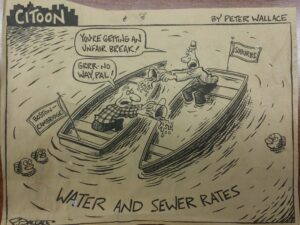
Historical political cartoon by Peter Wallace. Advisory Board archives.
The cartoon came from a period when disagreements over water and sewer rates could be fierce. In the 1990s, debates over sewer-rate methodology brought sharply different views from Boston and suburban communities into the same public process.
Yet the region also moved forward. Major investments were completed. Environmental conditions improved. And over time, a more sustainable and predictable approach to financing the system gave communities greater stability in planning their own budgets and rates.
That history doesn’t mean the intervening decades were free of disagreement. It means regional cooperation developed through those differences, not because they disappeared.
And now another significant investment cycle is approaching.
Another mountain on the capital horizon
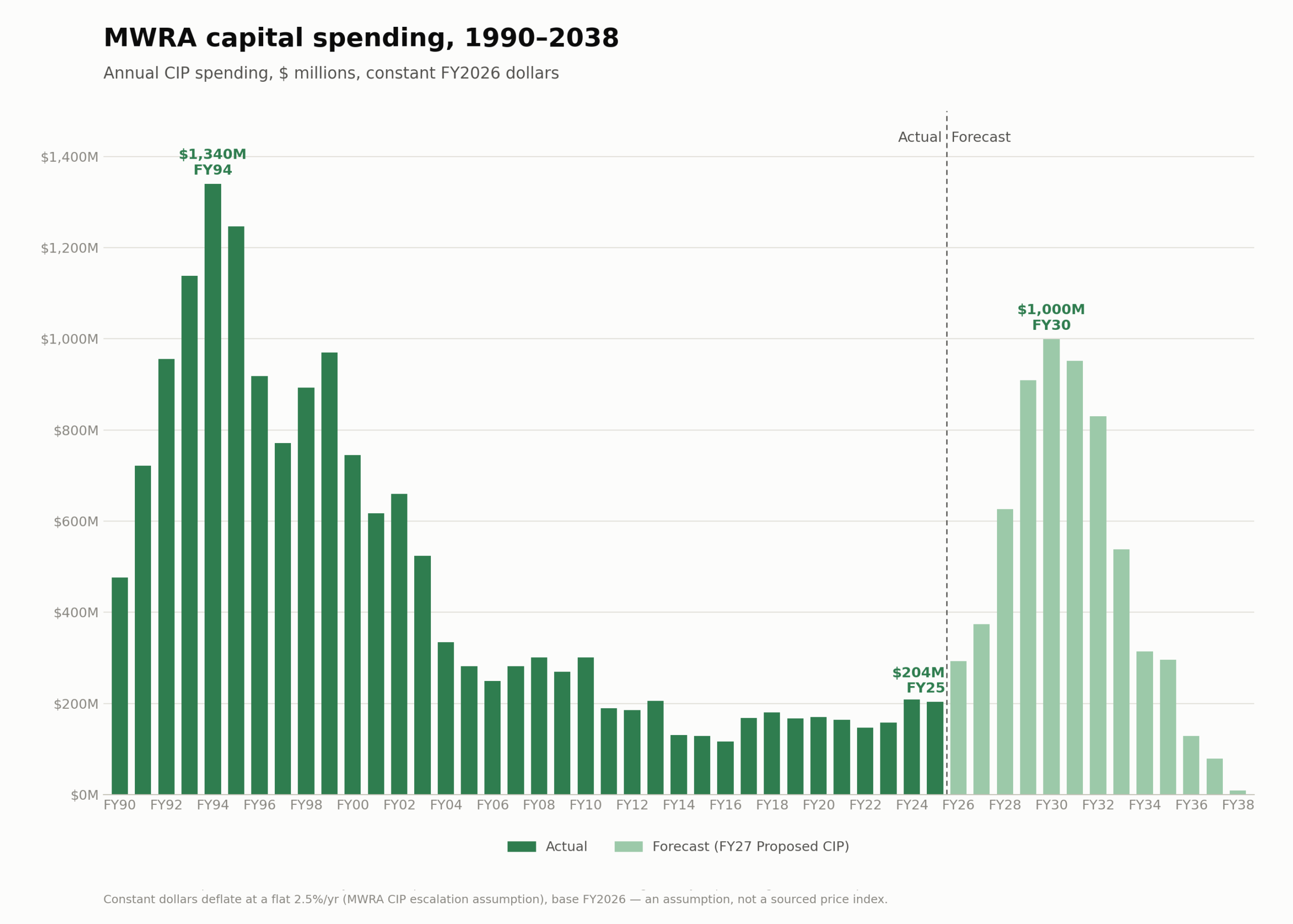
Capital spending in constant FY2026 dollars. Source: Advisory Board analysis of MWRA’s January 2026 Proposed FY27 CIP, presented September 24, 2026. The forecast predates additions to the June Final FY27 CIP.
The pattern is striking.
Capital spending climbed dramatically during the first major era of MWRA construction, reached its historical peak in the 1990s, and then declined into a long period of comparatively lower spending.
The forecast shows another substantial increase ahead, with projected annual spending approaching $1 billion around FY2030, expressed in constant FY2026 dollars.
The projects behind that increase are not optional luxuries. They include Metropolitan Water Tunnel redundancy, major investments in protecting and renewing Deer Island, and other essential water and wastewater infrastructure.
But those are not the only major investments that could lie ahead.
The chart reflects MWRA’s January 2026 proposed FY27 capital forecast. Since then, MWRA’s final FY27 CIP has incorporated $772.4 million in planned spending for seven future CSO projects.
But including those projects in the capital budget is not the same as final regulatory approval of the Updated CSO Control Plan. The ultimate scope, implementation, financing, and cost allocation remain subject to further decisions.
Whatever emerges from that process will need to be managed alongside MWRA’s other major infrastructure commitments.
That broader picture changes how we should understand the October 22 vote.
The question is not simply which level of CSO control the region should pursue. It is also how the resulting commitments will fit among the other major investments the region will need to finance, schedule, construct, and operate.
MWRA’s ability to deliver that work matters, too. Workforce capacity, engineering resources, construction management, and the practical limits of implementation deserve attention alongside the financial projections.
Many of these investments are necessary. That is precisely what makes the choices difficult.
The work ahead
It would be easy to look at a divided vote and see a regional organization struggling to agree.
But an Advisory Board that represents communities with different circumstances, obligations, and priorities should not be measured solely by how often its members reach the same conclusion.
It should be measured by whether those perspectives are heard, the tradeoffs are understood, and the resulting decisions serve the region responsibly.
The October 22 vote did not resolve every question surrounding the Updated CSO Control Plan. The regulatory process continues, and decisions about implementation, financing, and community impacts will follow.
Nor will it be the last time the Advisory Board is asked to weigh substantial environmental or infrastructure benefits against substantial costs.
The next generation of regional investment will demand the same discipline, and perhaps more: a willingness to support necessary improvements, question whether their value justifies their burden, and make room for legitimate disagreement without losing sight of shared responsibilities.
A divided vote is not necessarily a failure of regional cooperation. Sometimes it is evidence of the difficult work that meaningful cooperation requires.
That work mattered when the region was building the system we rely on today. It matters in the CSO decisions before us now.
And it will matter just as much in deciding what we build next.
Explore the decision
- The Advisory Board’s CSO Resources Hub includes explanatory material and community-cost tools.
- See meeting materials and minutes (once approved) on the meeting’s event page: October 2026 Advisory Board meeting